

Past Events
In Conversation with:
Dr Christian Hirst
Monday, 15th May 2023
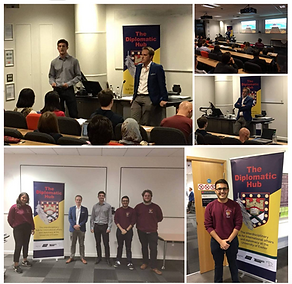
We were honoured to host Dr Hirst from the Australian High Commission in May 2023. After providing a fascinating recount of his career in various Australian government departments, there was a stimulating Q&A with Dr Hirst in which various subjects like the future of British-Australian security cooperation amid the recent AUKUS agreement, as well as how Australia is helping Britain establish greater trade links following Brexit. This conversation continued as students had the opportunity to ask questions directly in a networking session that followed the event. We are very grateful for Dr Hirst's time and thought-provoking discussion, and look forward to hosting him again in the future!


In Conversation with:
Ambassador José Marco Martinez
Thursday, 26th January 2023
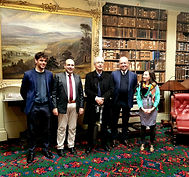
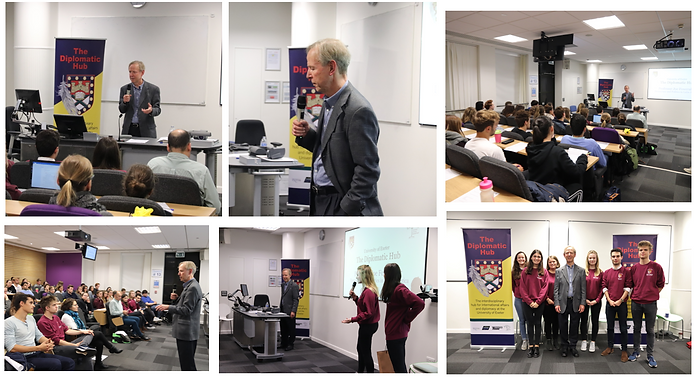
On Thursday 26th of January, The Diplomatic Hub was honoured to host the Spanish Ambassador to the United Kingdom and Northern Ireland, José Pascual Marco Martínez at the university. On the first sunny day in weeks, the Ambassador received an expert historical tour of the city facilitated by Jesse Lynch, a PhD student at the university, followed by a tour of the Reed Hall gardens. Throughout the day, Ambassador Marco also met with senior staff at the university, including the Vice-Chancellor, Lisa Roberts, the Deputy Vice-Chancellor for Global Engagement, Richard Follett, and many other staff from Hispanic Studies and Politics.
The central element of the day was the Ambassador’s lecture, delivered to an audience of 70 students and professors. This fascinating and interactive insight into the life of an ambassador was a fantastic example of the value of these events, with Ambassador Marco detailing his experiences of working in diplomatic missions around the world and illuminating us on Spain’s relationship with Britain post-Brexit. A tremendous amount of work went into this event, in particular from the Global Partnerships team and the SPSPA and History departments, for which the Diplomatic Hub is very grateful.
Testimonials of student's experiences can be found here.




Gabriela Castro Fontoura
Trade and Opportunities in Latin America
Monday, 28 September 2020
On 28th September 2020, we warmly welcomed Gabriela Castro-Fontoura for a talk on Trade and Opportunities in Latin America. Gabriela founded her own company, Sunny Sky Solutions, and works to supporting British businesses across Latin America. Gabriela is also the proud author of “The SME Guide to Latin America” - an e-book on the region for British SMEs. This discussion was moderated by our Presidents Francesca Descher and Sarah-Ann Lim.
Gabriela leveraged on her experiences working in the UK and Latin America to paint a picture of the economic situation in both countries, outlining opportunities for growth especially in a post COVID-19 world. She highlighted the diversity of Latin America, giving us a unique insight into the local culture and working style. Throughout the conversation, Gabriela also integrated career tips for those interested in entrepreneurship and international trade as well as her inspiring story of how she eventually set up her own company.
The event wrapped up with a Q&A segment where we received many questions about trade diversification opportunities in Latin America, as well as how her consultancy business is adapting to restrictions put in place due to the health crisis.
Our committee would like to thank Gabriela for her time and insight, as well as everyone who took time off their schedules to attend this event. We hope this event provided the audience a greater insight into Latin America beyond the classroom.


Exeter Lecturers Roundtable
Politics of the Pandemic
Wednesday, 23 September 2020
This was the first event for the 2020/21 committee, and due to the Covid-19 pandemic, the first ever virtual event the Diplomatic Hub has run as well. For this panel disussion on the 'Politics of the Pandemic' we were joined by Professor John Heathershaw, Dr Irene Fernandez-Molina, Dr Nick Kirsop-Taylor, and Dr Elena Gadjanova from the University of Exeter Politics Department. All had been contributories to pandemipolitics.net, a blog set up by Heathershaw and his colleague Dr Brieg Powell to explore the sociopolitical issues to the pandemic. The discussion was moderated by the Diplomatic Hub's Publicity Secretary, Georgia Mealings.
The event started with questions on the UK experience of the pandemic, with Nick and John talking about the institutional weakness of the British response due to austerity and avoidance of political responsibility. In particular John highlighted the tendency of politicians to hide behind the mantra of 'we're following the Science'.
Though perhaps the most enlightening part of the event was the discussion of exceptionalism, especially with regard to the UK. Irene spoke on how the stereotypes that persist against Southern Europe shaped the early perception of the pandemic, despite the high quality of healthcare in countries like Italy. Elena similarly lamented the reluctance of countries in the West to take the warnings of Asian countries and embrace international cooperation.
At the end of the event we had time for some questions from attendees, which included a question on the balance between public health and the economy.
We would like to thank all who tuned into this event and submitted questions ahead of time, it was great to see such a large turnout for our first event. And of course we are hugely thankful for our four panelists for giving up their time and expertise, we urge you to check out their pieces on the pandemipolitics blog.
The Great Debate
Are Human Rights the Newest Form of Western Imperialism?
Monday, 9th of March 2020
Our first ‘grand debate’ took place on March 9th 2020, discussing the question of ‘are human rights the newest form of Western imperialism?’. Run jointly with Afro-Caribbean Society, this lively and engaging debate engendered constructive conversations about the tensions inherent in the ‘universal’ idea of human rights.
The debate opened with statements from students representing the for and against positions, before opening up the floor to the audience. Moderated by one of the Diplomatic Hub’s Event Managers, Shayna Lewis, a friendly and inclusive discussion developed ranging from the inception of the postwar human rights order to issues associated with more recent armed conflicts. The debate became particularly interesting where students grappled with the ideal of human rights as a universal and egalitarian idea, and the practicalities of their application and potential exploitation in the international humanitarian interventions which have proliferated since the 1990s.
The event was a great opportunity for students to develop their public speaking and debating skills. It also gave students from a variety of academic disciplines the chance to hear the valuable perspectives which other subjects could offer to this topic, matching with the Hub’s purpose of creating an interdisciplinary forum for students interested in international affairs.
We would like to thank all the students who came to and engaged with this well-attended event, and the Afro-Caribbean Society committee for working with our committee to run it.


Rupert Joy
On External Relations: UK and EU
Tuesday, 3rd of March 2020
On March 3rd 2020, we were pleased to welcome Rupert Joy for a talk on UK and EU diplomacy. Now working as an international consultant, Rupert occupies the unique position of having worked as a UK Ambassador to Uzbekistan and EU Ambassador to Morocco.
In a wide-ranging talk, Rupert took us through his background as a British diplomat in various roles at the Foreign Office in London and embassies overseas. This provided excellent context for his explanation of the differences between British and EU diplomatic work. Whereas British diplomats abroad usually focus on political and economic affairs, EU missions are often highly technical in nature. Equally fascinating was Rupert’s first-hand account of the distinctive culture of EU missions, with the multinational character of his staff in Morocco meaning that he truly ‘felt European’ during his ambassadorship.
On the EU itself, Rupert judged that it was a capable but often hamstrung player on the international stage. Whilst the negotiation of the 2015 Iranian nuclear deal testifies to the EU’s ability to play a mediating role internationally, the need for the agreement of all of its member states on foreign policy meant that a global ‘EU voice’ was often hard to achieve.
Our committee would like to thank Rupert for his excellent talk, and everyone who came to this well attended event. The event provided a great opportunity for students to learn directly about the life of a diplomat, building into the Hub’s goal to enrich students’ understanding of international affairs beyond their studies.


Aftershock
Crisis Simulation
Friday, 31st of January 2020
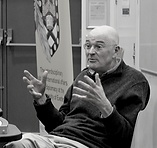
On Friday 31st of January 2020, the Diplomatic Hub was excited to run our annual ‘crisis simulation’ for students in collaboration with the Strategy and Security Institute and the University of Exeter. Students who had been competitively selected to participate took on roles as key decision-makers responding to an earthquake scenario, based in the fictional country of Carana. Over the course of the day, different groups ranging from the national government to the United Nations sought to limit the climbing death toll through making complex decisions on matters of relief supply and coordination. This required a mixture of strategic foresightedness and on-the-spot decisions in response to the events of the simulation as they unfolded in real-time. Whilst the national government and NGO teams scored the highest for points rating their effectiveness, together the students displayed exceptional collaborative skills and ability to deliver at a pace.
For the participants, the simulation provided an excellent insight into how governments and international organisations deal with moments of crisis. Combining consideration of the long-term implications of decisions relative to one’s overarching objectives, and making the most effective choices in a time-limited scenario, built a skill-set which is highly sought after in these institutions. The crisis simulation, run by the Diplomatic Hub every year for the last three years, is particularly effective training for students excited by the prospect of working in international politics and security. It testifies to the multifaceted nature of the Hub’s work for the student body, through which students are not only able to gain unique insights into diplomacy but also important career-building experiences.
The Diplomatic Hub committee would like to extend its thanks to all of the students who participated so enthusiastically on the day, and in particular the head of the SSI Martin Robson for overseeing the simulation itself. We look forward to next year’s event.


James Nixey
On UK-Russia Relations
Monday, 9th of December 2019
The Diplomatic Hub was pleased to welcome James Nixey, the Director of the Russia and Eurasia Programme at Chatham House, for a talk on UK-Russia relations on December 9th 2019.
Contextualising the bilateral relationship between the UK and Russia, James gave a fascinating analysis of how the Kremlin understands its place in global affairs. Following the identity crisis in Russia of the 1990s following the fall of the Soviet Union, he explained how the era of Vladimir Putin’s de facto leadership of the country throughout the twenty-first century had seen an effort to reclaim a Russian role in the world. James argued that Western observers often misunderstood the actions of the Russian government as illogical, flouting the rules-based international order out of maliciousness. In fact, James emphasised, the Russian government saw this order as fundamentally debased and hypocritical. This sentiment only increased following the American-led invasion of Iraq, which has given the Russian state a clear basis on which to criticise the actions of the West as a whole.
On the topic of UK-Russia relations itself, James explained how the Russian government perceives the UK very differently to how the British government perceives itself. In contrast to the common understanding shared by British politicians and diplomats that the UK ‘punches above its weight’, the Russian state sees Britain as a power on the ebb. Oftentimes awkwardly positioned between the conflicting strategies of the United States and European Union, Britain has been unable to present to the Russian government itself as a decisive power. Instead, James suggested, the Kremlin and Putin ultimately saw the UK as a respectably middling albeit largely insignificant power on the world stage. The dichotomy James described between British and Russian government perceptions was one of the most intriguing areas of the talk.
The Diplomatic Hub would like to thank the attendees who came from the student body and beyond for coming to the event, and James Nixey for travelling down from London to deliver his excellent talk.
Did you miss the talk? Follow this link to access the recording.


Lessons from Windrush
Diplomatic Talks with the Jamaican High Commissioner
Monday, 11th of November 2019
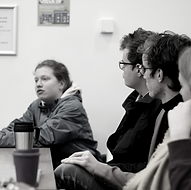
On Monday the 11th of November the Diplomatic Hub was delighted to welcome His Excellency Mr Seth George-Ramocan, the Jamaican High Commissioner to the United Kingdom, to Exeter for a stimulating talk on Jamaica-UK relations. The excellent turnout for the talk reflected the substantial interest of students in the valuable place of the Windrush generation in British society. The event put into sharp relief the importance of diplomacy beyond the state-to-state level.
The High Commissioner’s central message was that the UK and Jamaica need to be proactive in valuing their relationship at both the state and society level. The Windrush scandal of 2018 was met with mass public incredulity at the sinister way in which the British government, through its hostile immigration policy, had been treating Caribbean citizens. Contextualising the large diaspora of Jamaican and, more broadly Caribbean people, in the UK today, the High Commissioner emphasised that the relationship between Jamaica and the UK was historically intimate.
After the Second World War, during which hundreds of Jamaicans gave their lives fighting for the Allied cause, the UK encouraged immigration from the Caribbean through official government policy. The Carribeans who headed the call contributed immensely to British society. Postwar Britain depended on the work of migrant labour to rebuild, following mass labour shortages. Yet equally, if not more significant to British society, has been the enrichment by Caribbean culture, reflecting a cultural mixing to which contemporary celebrations such as the Notting Hill Carnival testify. This rich history formed the backdrop to High Commissioner’s call for Britain to not neglect such valuable contributions by Jamaicans to UK society.
High Commissioner Ramocan used this context to lead us to the Windrush Scandal of 2018, which lamentably continues to unfurl today. The Windrush Scandal was unique in the way in which domestic and foreign affairs collided. It was fascinating to hear about how the group of Caribbean Ambassadors to the UK had coordinated and targeted their diplomatic efforts with the British government during the crisis. Such an effort, the High Commissioner reflected, was a testament to the significance of the incident. This was the great strength of High Commissioner Ramocan’s talk: demonstrating the importance of diplomacy to society at large beyond the revered halls of embassies and foreign ministries.
Did you miss the talk? Follow this link to access a recording.


On Monday the 11th of March, the Diplomatic Hub and Scandinavian Society hosted Their Excellencies Lars Thuesen, Wegger Chr. Strømmen, and Torbjörn Sohlström, Ambassadors to the UK for Denmark, Norway and Sweden respectively.
The Ambassadors discussed their roles, and what it involves day-to-day. They also gave an insight into their career path, discussing what skills and experience is needed to become a diplomat. Finally, they touched upon Scandinavia's relationship with the UK, and how events such as Brexit are redefining the European and global landscape.
If you missed the talk and would like to view it, it is available here.
We would like to thank the Ambassadors for their time, and for providing a unique insight for students into life as a diplomat.

Diplomatic Talks with the Scandinavian Ambassadors

Diplomatic Hub x Scandinavian Society
Monday, 11th of March 2019


In his talk, Tim Rühlig provided his take on this question aiming to provide a better understanding through Chinese lenses. His insights are mostly drawn from extensive field research in the PRC including more than 150 in-depth interviews that he conducted with policy-makers, their advisors, business leaders, think tanks, academics and activists. Apart from the mere research results, he will aim to introduce and discuss with the audience his own research approach, aspirations and self-perception of his work as well as how work on China relates to us as European citizens deeply believing in democracy, human rights and the rule of law. His current research focuses on Europe-China relations in general and China’s growing footprint in technical standardization particularly in the fields of new technology such as 5G internet and Artificial Intelligence in particular.
Wednesday, 6th of February 2019
DR TIM RÜHLIG
How is China's rise changing the liberal international order?


The Diplomatic Hub
AFTERSHOCK: A HUMANITARIAN CRISIS SIMULATION
Friday, 25th of January 2019
On Friday the 25th of January, 16 students took part in a crisis simulation based on the board game Aftershock. The simulation was run with the support of Dr Martin Robson from the university's Strategy and Security Institute. Acting as the Government of Carana (based on Haiti), the Army, the UN and NGOs, teams worked together to respond to a natural disaster on the island. Teams had to take it in turns to rebuild the port and airport, co-ordinate supplies to support damaged districts, and prevent loss of life. These tasks were made harder by limitations set on each group, such as certain groups not having infrastructure-building capabilities. Students were forced to negotiate strategies with each other to address areas in a state of emergency, and ensure aims were met.
The complexities teams faced in their decision-making process was designed to reflect the complexity of disaster relief. As well as tackling logistics and supply issues, cards turned on each go created further problems for the groups, such as mass illness appearing in certain districts. Trying to balance long term aims with solving immediate issues, teams had to think strategically to reduce possibility of human loss, and plan ahead for upcoming issues.
One student remarked ‘I had an excellent time at the crisis simulation. The opportunity to apply the theories of strategy in a real-world scenario was invaluable and incredibly challenging. I learnt a lot about decision-making and feel better prepared for when I will be faced with tough decisions.’
We would like to thank Dr Robson for his support, and the students that participated.

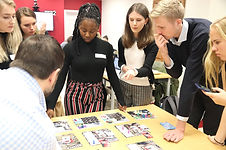


The British Foreign Policy Group hosted the PPE Society, the Politics Society, Diplomatic Hub and Conflict, Security and Peace Society in the ‘The Exeter Politics Summit: The UK Aid Programme’’.
Led by panellists Myles Wickstead, Judith Smith, Dr John Heathershaw and Dr Neil Adger, the panel discussed issues with and realities of UK aid spending and its intersection with foreign policy objectives. It was a fantastic chance to engage with leading experts on the UK aid programme to find out what it is and why it matters.
This event is part of the BFPG’s National Engagement Programme, a nationwide series of events which aim to generate greater public discussion about the UK’s international position and choices.
Monday, 3rd of December 2018
The UK Aid Programme: What it is and why it matters
The Exeter Politics Summit


Democracy and Politics in Latin America
PROFESSOR JOE FOWERAKER
Tuesday, 6th of November 2018
Our second event of the year welcomed Professor Joe Foweraker to the university.
Having spent many years studying Central and Latin America, Prof. Foweraker provided a unique insight into the region. Discussing ideas of democratic theory, the idea of state and oligarchy, attendees learnt about ideas of formal and informal power, and how the relationship between the two shapes this region.
Drawing on ideas from his new book, 'Polity: Demystifying Democracy in Latin America and Beyond', the audience were encouraged to stop discussing 'democracy', and instead think of these nations as 'polities'. Finally, Prof. Foweraker turned the discussion towards ideas of populism and its essential nature in Latin American nations.
We thank Professor Foweraker for his time and for providing us with such an engaging talk!
Truth and Power
SIR SHERARD COWPER-COLES
Friday, 5th of October 2018
On the 5th of October 2018, the Diplomatic Hub was honoured to welcome Sir Sherard Cowper-Coles to the University of Exeter.
Drawing on his extensive diplomatic experience, Sir Sherard gave a fascinating talk describing how large institutions facing complex challenges are prone to groupthink, and the need for courage and honest leadership in delivering true success.
The talk was followed by a round of Q&A, in which the students asked many interesting questions.
It was great to see so many interested people at the event!


Tuesday, 14th of November 2017
We were honoured to welcome the Polish Ambassador to the United Kingdom, Arkady Rzegocki!
This event was organised in collaboration with the University of Exeter’s Polish Society, which we found to be a great and interesting society to cooperate with.
His Excellency, Arkady Rzegocki held a short, yet insightful talk about the history of Polish-British relations as well as how Brexit has and will impact the two countries’ relations in the future.
After the talk, the room was opened for questions, the audience impressing with interesting questions for the Ambassador, such as whether there is an explanation for increased Polish migration out of the country despite a growing economy.
After the talk and Q&A there was opportunity for networking.
It was great to see so many interested people at the event, and that a number of people not affiliated with the University of Exeter came too!
His Excellency ARKADY RZEGOCKI
Polish Ambassador Visit


Conversations on Nuclear Diplomacy
DR DAVID BLAGDEN
Thursday, 19th of October 2017
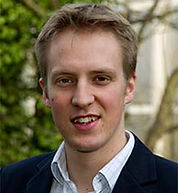
The Diplomatic Hub’s first event of the year saw the talented Dr David Blagden inform and enlighten his audience on nuclear affairs, touching on contemporary examples and case studies such as the UK, US and North Korea.
Dr Blagden also attempted to answer the question ‘What to do if diplomacy fails?’, giving his thoughts on this subject. This is especially relevant in the current times of crisis coming from North Korea.
After his lecture came a a 30 minute long Q&A session, with many members of the audience asked interesting, thought-provoking questions, and were hopefully satisfied with the answers they were given!
We thank you for coming!

Crisis Simulation
SOUTH CHINA SEA
Friday, 23rd of February 2017
On the 23rd of February The Diplomatic Hub held a South China Sea crisis simulation.
Students participated in a simulated crisis situation on behalf of the key actors involved in the South China Sea dispute. They played mid-level National Security officials faced with a sudden dilemma that needs a quick resolution taking into account other actors' unilateral objectives and national interests.

Minister Counsellor Visit: Sweden’s Feminist Foreign Policy
MINISTER COUNSELLOR ULRIKA FUNERED
Thursday, 24th November 2016
The Diplomatic Hub invited Minister Counsellor Ulrika Funered to address questions on feminist foreign policy and Sweden’s role on the UN Security Council in 2017-2018.
The Minister Counsellor is stationed at the Swedish Embassy in London where she works as the Deputy Head of Mission, and was therefore able to shine a light on all these questions and more.
The talk was followed by a round of Q&A, as well as a catered reception where students had the opportunity to further talk with the Minister Counsellor.


U.S. Lobbying and the Upcoming Elections
DR AMY McKAY
Monday, 17th October 2016
Many questions were raised as a result of the unusual American Presidential election in 2016. For instance, what role will corporations, pressure groups and financial loopholes play in influencing the result of the election?
The Diplomatic Hub’s first event of the academic year sought to address these questions in a lecture and Q&A session with lecturer Dr Amy McKay.
Dr Amy has published a number of articles on lobbying in the U.S. In 2008-9 she served as an American Political Science Association Congressional Fellow, working for a U.S. senator on health reform legislation (Obamacare).


The Diplomatic Hub Goes to the Spanish Embassy
Tuesday, 24th May 2016
The Diplomatic Hub was invited to visit the Spanish Embassy on May, 24th. The Diplomatic Hub students attended a talk given by Juan López-Herrera about Spain-UK bilateral relations and the challenges that Diplomacy will face in the coming years. The talk was followed by an informal discussion that covered a wide range of topics such as Brexit, Diplomacy, Latin America, literature, etc.
It was a very fruitful event and we are very grateful to the Spanish Embassy, specially the Minister Councillor, Juan López-Herrera for hosting us.

Diplomatic Talks with Ambassador Dr Martin Eichtinger
Thursday, 10th March 2016
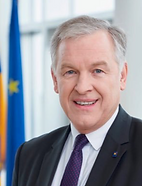
This event featured the Ambassador of the Austrian Republic to the United Kingdom, Dr Martin Eichtinger.
The event took place on March 10th at 19h in Streatham Court D.
CV Austrian Ambassador Dr. Martin EICHTINGER, short [106938]


Conversations on Climate Change
DR TRAVIS COAN & TREVELYAN WING
Friday, 19th February 2016
Dr. Travis Coan (Ph.D., Claremont Graduate University, 2011) is a Lecturer in Quantitative Political Science and an academic staff member at the University of Exeter’s Q-Step Centre. Before joining the Politics Department at Exeter, Travis was a Statistician and Lecturer on Law at Harvard Law School, where he directed the Empirical Research Services group and taught applied quantitative analysis. While Travis’ research spans a diverse set of topics in political science, his most recent work applies advances in text-mining and natural language processing to examine the relationship between climate change scepticism, public opinion, and environmental policy. Travis’ methodological interests include the study of causal inference with experimental and observational data, text analysis, and Bayesian statistics. His work has appeared in International Studies Quarterly, International Interactions, and Political Psychology, among others.
Trevelyan Wing is the Yungtai Hsu Scholar in Environmental Change and Management at St John’s College, University of Oxford, and a Fellow of the Climate Institute in Washington, DC. Raised and educated on three continents, he has worked with the U.S. Mission to the United Nations in Geneva on issues including human rights and the environment, and as a delegate to the 1st U.N. Global Youth Summit led the drafting of sustainable development goals for the 2013 Costa Rica Declaration. Trevelyan graduated Phi Beta Kappa from Dartmouth College, where he chaired the Council on Climate Change and conducted fieldwork into the effects of climate change on Arctic communities. He founded the Indigenous Youth Forum on Climate Change in 2014 to promote dialogue, knowledge exchange and shared problem solving on climate issues. Trevelyan’s current research focuses on the social sustainability of renewable energy, and his ambition is to work at the intersection of science and policy to help governments and other institutions adopt sustainable practices and, ultimately, transition to a genuinely green global economy.


Conversations on the Refugee Crisis
PROFESSOR MICHAEL DUMPER & JAMIE WELLS
Thursday, November 17th 2015
Michael Dumper is Professor in Middle East Politics, University of Exeter. His research is primarily on the Arab-Israeli conflict, especially future options for Palestinian refugees and for Jerusalem, and the politics of archaeology and conservation in the urban Middle East. In addition to his new book, Jerusalem Unbound: Geography, History and the Future of the Holy City (2014) he is author of The Future of the Palestinian Refugees: Towards Equity and Peace (2007); The Politics of Sacred Space: The Old City of Jerusalem and the Middle East Conflict, 1967-2000, (2001); The Politics of Jerusalem Since 1967 (1997); editor of Palestinian Refugee Repatriation: Global Perspectives (2006).
Jamie Wells holds a masters degree in Three Dimensional Design from the RCA and an OU masters degree in Equality and Diversity. He has worked in Education for more than 25 years as a teacher and facilitator. He was head of Department for Design in a leading comprehensive secondary school and had a senior role in outreach work facilitating and training teachers in teaching and learning styles suited to all but mainly those who were denied access to education due to their behaviour. Jamie has been a Division Secretary for the National Union of Teachers for 9 years and for 15 years has been an elected member of the NUT National Advisory Group for Health, Safety,Welfare and Well-being (with a particular interest in Mental Health and Women’s Issues). He has spoken at National Conferences on Human Rights and on the Occupation of Palestine. He has visited Palestine many times and shown solidarity with Trade Unions and educationalists internationally. He has worked with Amnesty, Palestine Solidarity Campaign and Defence for Children International in Palestine. He is a passionate campaigner and activist.

